
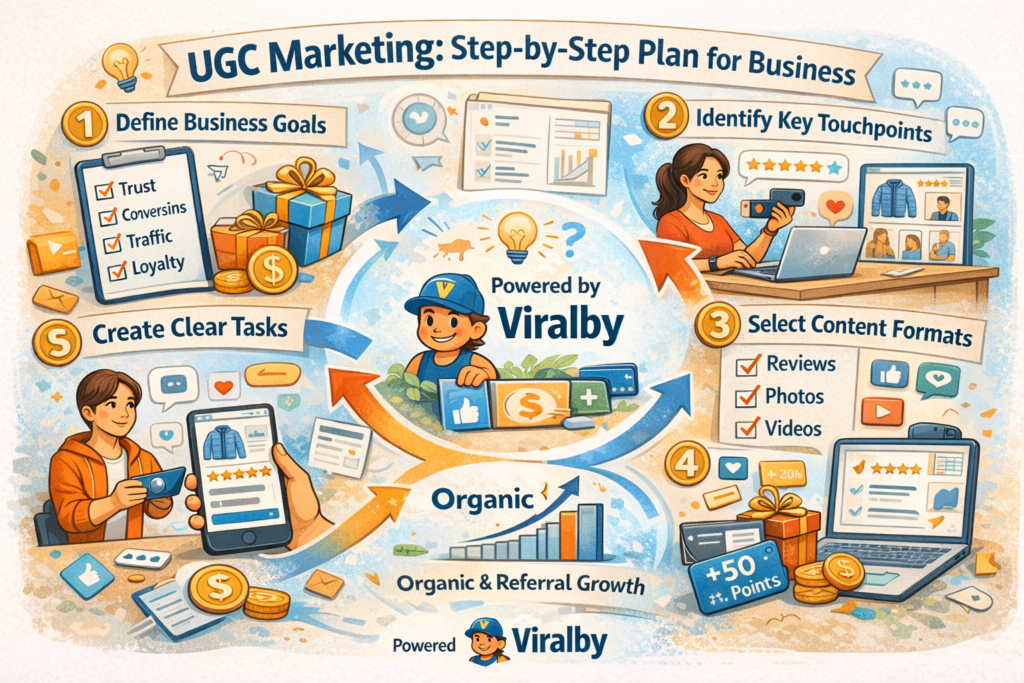
Many companies understand the value of customer-created content, but struggle to turn it into a working system. UGC marketing often looks chaotic from the outside. Below is a clear, step-by-step plan that helps businesses launch UGC marketing in a structured and manageable way.
Step 1. Define the business goal, not just “get reviews”
The most common mistake is launching UGC without a clear objective. Content for the sake of content rarely delivers results.
At the start, businesses should answer one simple question: what problem should customer content solve?
Most often, the goals include:
- building trust in the product
- improving conversion rates
- increasing repeat purchases
- reducing dependency on paid advertising
- growing organic and referral traffic
- strengthening brand expertise
The chosen goal defines the content formats, platforms, and customer participation scenarios.
Step 2. Identify where customer content matters most
UGC performs best at moments of uncertainty. These usually include:
- product or pricing pages
- comparison and evaluation stages
- the moment before purchase
- the period after the first transaction
Understanding these touchpoints early prevents collecting content that never gets used.
Step 3. Choose 3 to 5 content formats to start
At the beginning, it is better to focus than to cover everything. A few proven formats are enough.
For SMB, SaaS, and EdTech, the most effective formats usually are:
- short experience-based reviews
- screenshots or photos of real usage
- brief videos explaining how the product helps
- mini case stories showing before-and-after results
- recommendations in relevant communities
These formats are easier to manage and scale.
Step 4. Turn requests into clear tasks
“Please leave a review” rarely works. Customers need clarity:
- what exactly to do
- where to do it
- what outcome is expected
Tasks reduce uncertainty and significantly increase completion rates. This is why UGC works best when it is task-based.
Step 5. Offer simple and transparent motivation
Customers rarely create content without a clear reason. They need to understand what they gain.
Motivation can include:
- discounts on future purchases
- bonuses or gifts
- free access or upgrades
- invitations to exclusive programs
Transparency is critical. Customers should immediately see the link between their action and the reward.
Step 6. Use Viralby to launch UGC as a system
At this stage, many businesses hit operational limits. Explaining tasks, checking results, tracking rewards, and measuring impact quickly becomes manual and inefficient.
Viralby brings this process into one system by allowing businesses to:
- create structured customer tasks
- define content requirements
- automatically track completed actions
- motivate customers with points and rewards
- analyze which formats deliver results
In practice, businesses often start with tasks like:
- writing a detailed review explaining how the product solved a specific problem
- publishing a short post or comment sharing personal experience and recommendations
- sharing a screenshot or photo of real product usage in a social or professional community
These tasks are easy for customers and generate content that directly supports trust and traffic growth.
Step 7. Launch a pilot before scaling
The best starting point is a small pilot:
- 2 to 3 tasks
- a limited group of customers
- clear metrics for evaluation
This approach helps validate formats quickly and refine the process without risk.
Step 8. Scale what works
After the pilot, businesses clearly see:
- which tasks customers complete most willingly
- which content influences conversions
- where customers are most comfortable sharing experience
Scaling then happens by expanding participation and scenarios, not by increasing spending.
Final thoughts
UGC marketing does not require complex launches or large budgets, but it does require structure. When customer content is embedded into a clear process, it becomes a stable growth channel.
For businesses that want to build marketing through customers, starting with a small UGC pilot is often the most effective first step. Platforms like Viralby make this process faster, cleaner, and easier to scale without manual overhead.