
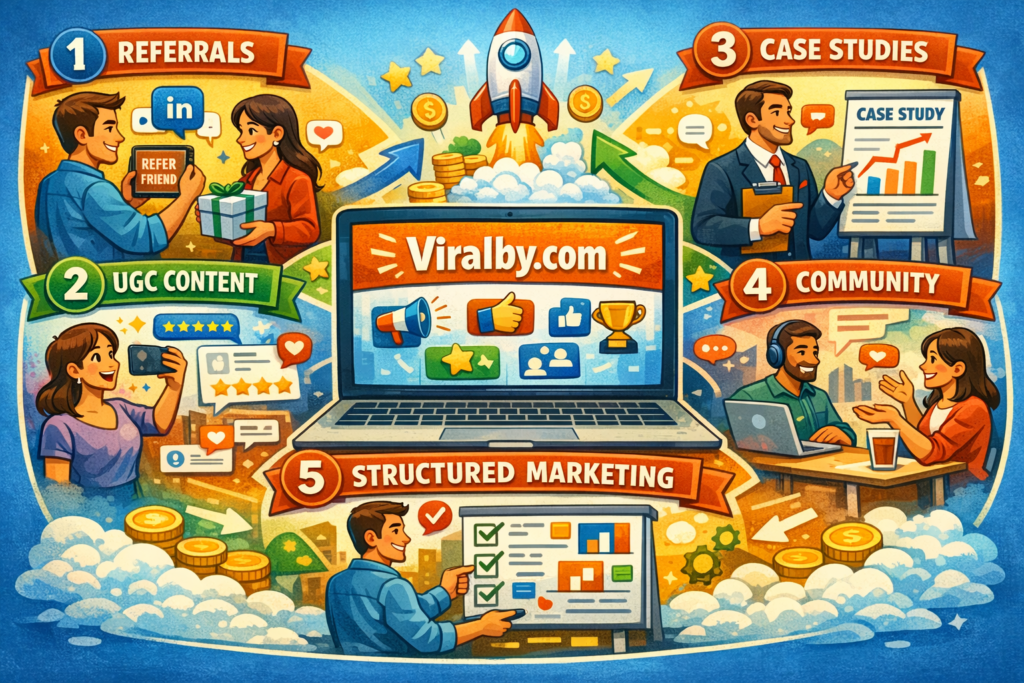
Traditional marketing is becoming more expensive while trust in advertising continues to decline. This is especially noticeable in B2B, SaaS, and education, where decision cycles are long, trust is critical, and paid channels are increasingly saturated. As a result, customer-driven marketing has moved from an experimental idea to a core growth strategy for many companies.
Below are five models that have already proven their effectiveness in real business scenarios and can be adapted to different types of organizations.
Model 1. Modern Referral Marketing
Classic referral programs are familiar to most businesses, but many of them underperform. The reason is simple: customers are asked to invite friends without being shown how, where, or why to do it.
Modern referral marketing works differently. Customers receive a clear scenario, not just a referral link. They understand what to say, which platform to use, and which audience to target. This could be a recommendation on LinkedIn, a post in a professional community, or a short story shared within an industry group.
In practice, structured referral programs often generate two to three times higher conversion rates than traditional “invite a friend” mechanics, mainly because they reduce uncertainty and improve traffic quality.
Model 2. User-Generated Content as a Continuous Channel
User-generated content is no longer something accidental. Companies that work systematically with reviews, testimonials, and customer stories create a stable flow of organic traffic.
The key factor is not volume, but consistency and relevance. One review per month rarely changes anything. A steady stream of 10 to 20 customer mentions over a quarter can significantly improve search visibility, social reach, and AI-generated answers.
Industry data shows that pages supported by authentic customer content often increase conversion rates by 20 to 40 percent compared to pages without social proof.
Model 3. Customer Case Studies as a Sales Tool
In B2B and education, case studies outperform almost any advertising message. However, many companies treat them as static assets and publish only a few polished success stories.
A more effective model involves continuously updating the case library and actively involving customers in the storytelling process. When clients describe results in their own words rather than marketing language, credibility increases dramatically. These cases are then used not only in marketing, but also in sales conversations, onboarding, and educational materials.
Model 4. Product-Centered Communities
Community marketing works especially well in SaaS and educational products. Private groups, professional communities, and customer clubs create an environment where the brand is present naturally rather than aggressively promoted.
The main value is not direct sales, but accumulated trust. Customers help each other, share experiences, and recommend the product organically. In these environments, recommendations feel like part of a conversation, not an advertisement.
Companies investing in communities often report retention improvements of 15 to 25 percent and lower churn over time.
Model 5. Structured Customer-Driven Marketing
The biggest weakness of all previous models is sustainability. Without structure, customer content appears irregularly, motivation declines, and results become difficult to measure.
This is where a platform-based approach becomes essential. Viralby helps turn customer-driven marketing into a manageable system. Businesses define clear tasks, customers understand what to do and why, and results are tracked transparently. This is especially important in B2B, SaaS, and education, where quality and relevance matter more than raw reach.
Final Thoughts
Customer-driven marketing is not a single tactic, but a combination of models that reinforce each other. Referrals, user-generated content, case studies, and communities are most effective when integrated into one coherent system and supported by clear incentives.
Companies that adopt this approach gain more than traffic. They build trust, visibility, and long-term growth that paid advertising alone can no longer guarantee.