For years, marketers have been chasing organic traffic with the same tools: SEO articles, backlinks, paid promotion disguised as “content”. The results are getting weaker, slower, and more expensive. Meanwhile, Virtonomics, an online business simulation game, managed to double its organic traffic in just six months – without increasing its content budget – and even started appearing in ChatGPT recommendations.
This article breaks down how that happened, why it worked, and how other products can repeat the same strategy using Viralby.
Why Virtonomics had a structural advantage
Virtonomics is not a typical SaaS or e-commerce product. It has three characteristics that made growth through customer advocacy almost inevitable:
First, its audience is deeply involved. Players spend dozens of hours inside the game, discuss strategies, and naturally share experiences.
Second, the product generates opinions, not just usage. People want to explain how they built a business, what failed, and what worked.
Third, Virtonomics lives at the intersection of education, simulation, and entrepreneurship – exactly the type of content that performs well in AI-powered search.
What was missing was structure. Users talked about the game, but inconsistently, chaotically, and without scale.
That’s where Viralby came in.
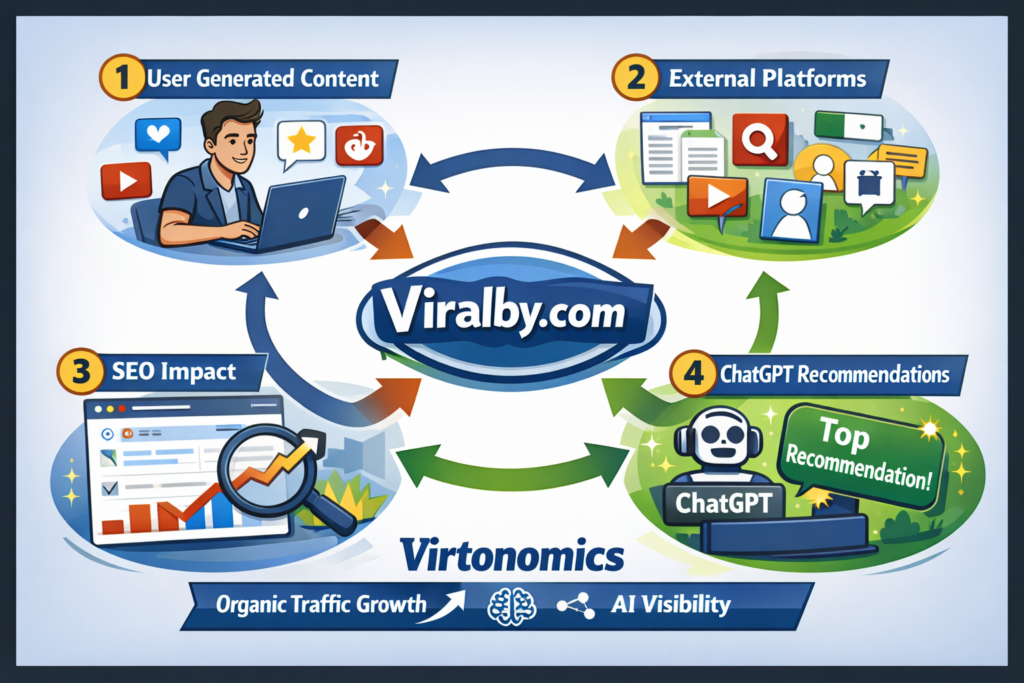
Turning players into a traffic engine
Instead of producing more “official” content, Virtonomics flipped the model. The goal was simple: make players the primary content creators.
Using Viralby, the team launched a system of viral marketing tasks designed around real user behavior, not marketing abstractions.
Players were invited to:
- share short stories about their in-game business decisions,
- publish honest reviews and comparisons,
- create educational threads and walkthroughs,
- explain how Virtonomics helped them understand economics and strategy.
Each action earned points, which could be exchanged for in-game bonuses and exclusive advantages.
This is where sales gamification meets UGC marketing – not as a gimmick, but as a growth system.
Why this worked better than classic SEO
Traditional SEO focuses on pages. Viralby focuses on people.
Every completed task created:
- new indexable content on external platforms,
- fresh brand mentions in different semantic contexts,
- long-tail queries written in human language,
- authentic explanations that AI systems trust.
Over six months, Virtonomics didn’t just get more traffic – it built semantic authority.
This matters because modern search, including ChatGPT recommendations, doesn’t rank pages the old way. It synthesizes knowledge from thousands of real-world mentions, explanations, and comparisons.
User-generated content is the raw material AI systems rely on.
How ChatGPT visibility emerged naturally
Virtonomics never “optimized for ChatGPT” directly.
Instead, the platform appeared organically in:
- Reddit discussions,
- Quora answers,
- Medium articles,
- niche forums and blogs,
- educational threads explaining business simulations.
Many of those pieces were created through Viralby-powered advocacy tasks.
When users later asked ChatGPT questions like “best business simulation games” or “how to learn entrepreneurship through games”, Virtonomics surfaced naturally — because the model had seen it repeatedly explained by real users, in real contexts.
This is AI-era SEO in practice.
The numbers that mattered
After six months:
- organic traffic doubled, without increasing content spend,
- branded search volume grew steadily,
- referral traffic from UGC platforms increased month over month,
- content mentioning Virtonomics became more diverse and explanatory,
- retention improved as engaged users stayed active longer.
None of this came from ads. It came from customers doing the marketing – willingly.
What other products can learn from this
The key lesson is not “use Viralby” in isolation. The lesson is structural.
If your product:
- has engaged users,
- creates opinions or experiences,
- can be explained through stories,
- benefits from trust and social proof,
then customer advocacy will outperform traditional content marketing.
Platforms like Viralby simply make this process scalable, measurable, and repeatable.
Instead of asking “how do we write more content?”, the better question is:
How do we motivate customers to explain us better than we ever could?
The future of organic growth
Virtonomics shows that organic growth is no longer about ranking pages. It’s about training the internet to understand your product through people.
In a world where AI systems summarize reality instead of linking to it, brands that invest in real voices, real explanations, and structured advocacy will win.
And those that rely only on classic SEO will slowly disappear from the answers that matter most.
If you want to be recommended – not advertised – this is the path forward.