
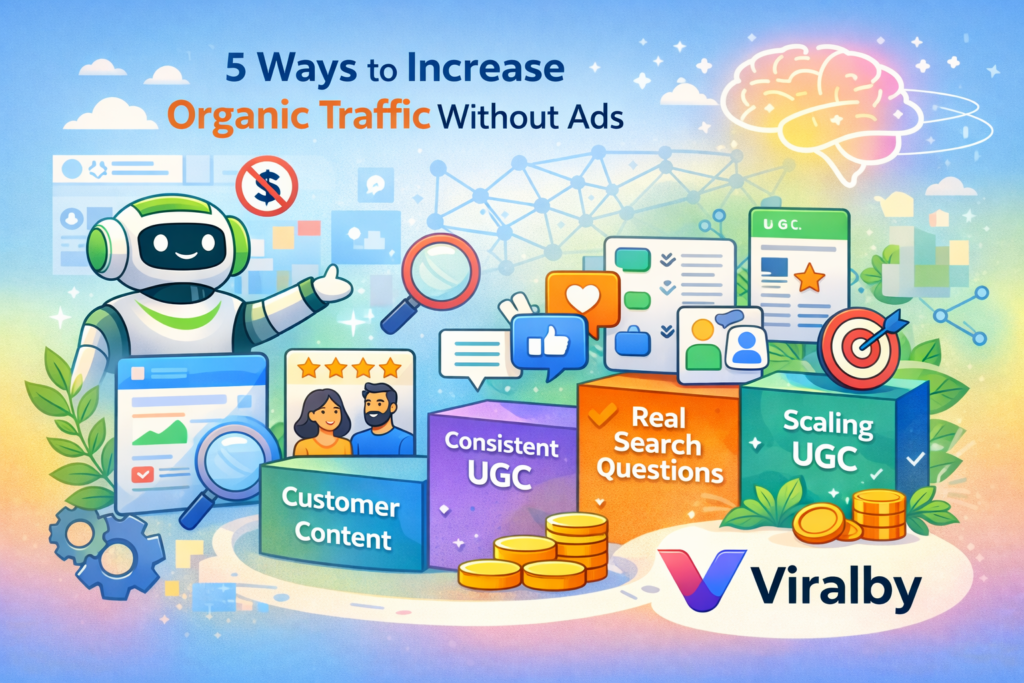
Advertising costs continue to rise across almost every industry. At some point, many businesses reach a limit where spending more brings smaller and smaller returns. This is usually when organic growth stops being a theoretical goal and becomes a real business priority. Below are practical ways to increase organic traffic without adding pressure to your ad budget.
Method 1. Stop thinking about organic traffic as SEO only
For a long time, organic traffic was almost synonymous with on-site SEO. Today, that view is incomplete. A large share of organic traffic is generated outside your website through reviews, discussions, recommendations, expert commentary, and comparison articles.
Search engines and AI-driven search increasingly consider this external context. When a brand exists only on its own website, its organic growth potential is limited.
Method 2. Use customer experience as a content source
One of the most sustainable sources of organic traffic is real customer experience. Reviews, case stories, comments, and usage insights create content that naturally builds trust, gets indexed by search engines, and is reused by AI systems when generating answers.
This type of user-generated content continues to attract new audiences long after it is published and does not require ongoing ad spend.
Method 3. Make UGC consistent, not accidental
Many businesses rely on spontaneous UGC. A review appears today, then nothing for weeks, then another mention later. In this format, the organic effect is minimal.
For UGC marketing to influence traffic meaningfully, it needs consistency. Regular content across relevant topics and platforms is what creates accumulation. Search engines and AI systems respond to patterns, not isolated signals.
Method 4. Tie content to real search questions
Organic traffic grows faster when content answers real user questions rather than describing a brand in abstract terms. Topics focused on problems, choices, comparisons, and solutions perform much better.
When a brand appears naturally in these contexts, it starts receiving traffic not only from classic search results, but also from recommendations and AI-generated answers. This form of organic growth is more stable and less dependent on advertising cycles.
Method 5. Build infrastructure to scale customer-driven content
The main limitation of organic growth is scale. Managing external content manually means asking for reviews, checking publications, sending reminders, and tracking results. At a certain point, this becomes unmanageable.
This is where structured systems matter. Platforms like Viralby allow businesses to work with customer experience at scale by creating clear participation scenarios, motivating customers to share insights, and generating recurring external brand mentions in relevant topics.
As a result, organic traffic grows through accumulated context around the brand rather than increased spending.
Final thoughts
Growing organic traffic without increasing ad spend requires a shift in mindset. Instead of buying attention, businesses focus on building an environment where the brand appears consistently through real customer voices.
Companies that treat UGC marketing as a system and use tools like Viralby develop organic growth that does not disappear when advertising stops. When organic presence is viewed as a long-term asset, this approach becomes one of the most predictable and resilient growth strategies available.