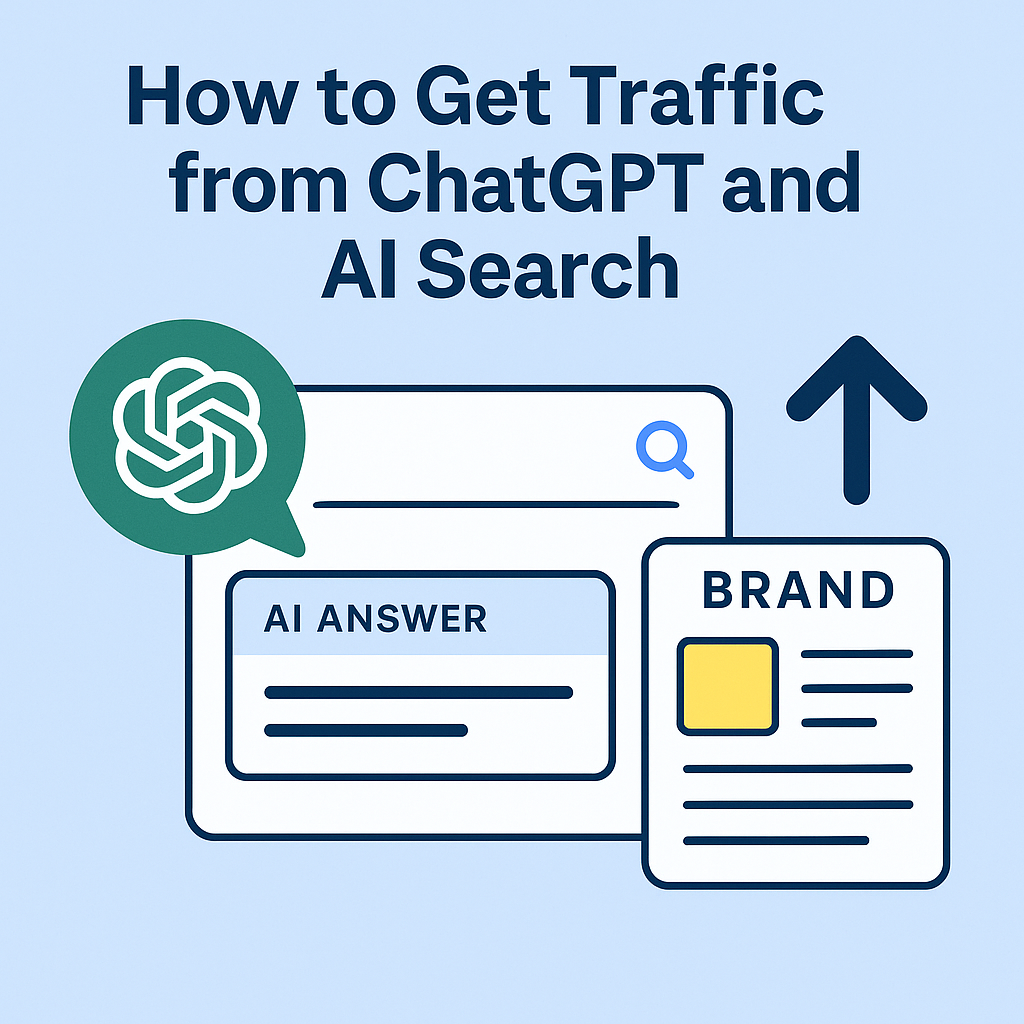
How to Get Traffic from ChatGPT and AI Search
AI search is changing how people discover brands. Here is a practical way to increase your chances of being mentioned inside AI answers, not just ranked in Google.
Why this matters: traditional SEO is losing surface area
If you work in marketing, you have probably noticed something that feels slightly unfair. You publish solid content, you keep your site healthy, you do all the usual SEO work, and yet organic traffic does not grow the way it used to. In many categories it even shrinks.
A big part of the explanation is simple: users are getting answers without visiting websites. They ask a question and an AI assistant summarizes the best options, or Google shows an AI overview that satisfies the intent immediately. The click that used to go to a blog post often never happens.
For a business, this creates a new kind of risk. It is not just about ranking lower. It is about not being referenced at all. When an AI answer lists tools, brands, or recommended approaches, you either show up in that shortlist or you do not exist in that moment.
3. Why the usual fixes do not solve AI visibility
Most teams react with familiar tactics: publish more content, improve technical SEO, build more links, increase ad spend. Those are not useless, but they do not address the core mechanism behind AI answers.
Ads do not buy you a mention inside a ChatGPT response. Technical SEO helps crawlers, but language models are not crawlers in the classic sense. Content on your own site matters, yet it is rarely enough on its own, because AI systems lean heavily on what the wider web says about you: reviews, discussions, comparisons, community posts, and repeated mentions across different contexts.
This is why many brands with a perfectly optimized website still fail to appear in AI recommendations. The web around them is quiet.
4. The shift: AI visibility is built on mentions and context
Think of AI visibility less like ranking and more like reputation. AI systems are pattern machines. They pick up repeated associations between problems, categories, and brand names. If your brand is consistently mentioned in places where people discuss a problem, share experiences, and compare options, you become easier to surface in AI answers.
This is also why short bursts do not help much. A one-off campaign can create noise, but AI visibility tends to be cumulative. What you want is steady, natural presence: real customer language, repeated use cases, and credible mentions on platforms that matter.
So the practical question becomes: how do you create that presence in a way that is scalable and not painfully manual?
5. How Viralby helps build AI visibility in a repeatable way
Viralby is built around a straightforward idea: customers are already your strongest credibility engine, but most businesses do not have a system to activate that engine reliably.
With Viralby, you create a set of viral tasks that guide customers toward specific actions that generate public, indexable content: reviews, posts, comments, simple comparisons, and other formats that naturally include your brand in context. Customers complete tasks and receive rewards. Because the tasks are repeatable and the rewards are immediate, participation becomes consistent rather than occasional.
The important part is the structure. You are not begging for reviews or hoping someone writes about you. You define what kind of customer content you need, where it should appear, and what a good submission looks like. Over time, this produces a steady stream of real-world mentions tied to the topics you care about.
6. Practical campaign example: “Be visible for best tools for X”
Let’s make this concrete. Imagine you sell a SaaS product and you want to be mentioned when someone asks ChatGPT something like “best tools for X” or “how to solve X”.
A simple campaign setup can look like this:
- Choose 3-5 topic clusters where you want visibility (for example: “best X software”, “X automation”, “X workflow”).
- Create customer tasks that generate natural mentions inside those clusters (review, short story of use, comparison with alternatives).
- Pick platforms that are publicly accessible and commonly referenced by AI systems (reviews, publishing, Q&A communities).
- Offer a reward that makes sense for your unit economics (discount, credits, perks, small gift).
- Track output over time: volume of mentions, diversity of platforms, repeated language patterns around your use cases.
This is not a one-week stunt. The point is to create a reliable cadence of public customer content that builds the associations you want AI to learn.
7. What results look like for a business
When this is done consistently, businesses typically see a few compounding effects. Brand demand grows because more people keep encountering the name in contexts that feel independent and trustworthy. Conversions improve because the social proof is not limited to your site. And over time, you increase the likelihood that AI systems mention you when users ask high-intent questions.
You are not just chasing traffic. You are building a durable presence that makes traffic cheaper across channels, including organic.
8. Soft CTA
AI search already answers your customers’ questions. The practical question is whether it will mention you, or keep naming the same competitors.
If you want a systematic way to build AI visibility through real customer content, Viralby is designed for exactly that. Explore how it works and launch a small, focused campaign first. You will learn more from one controlled experiment than from months of guessing.