
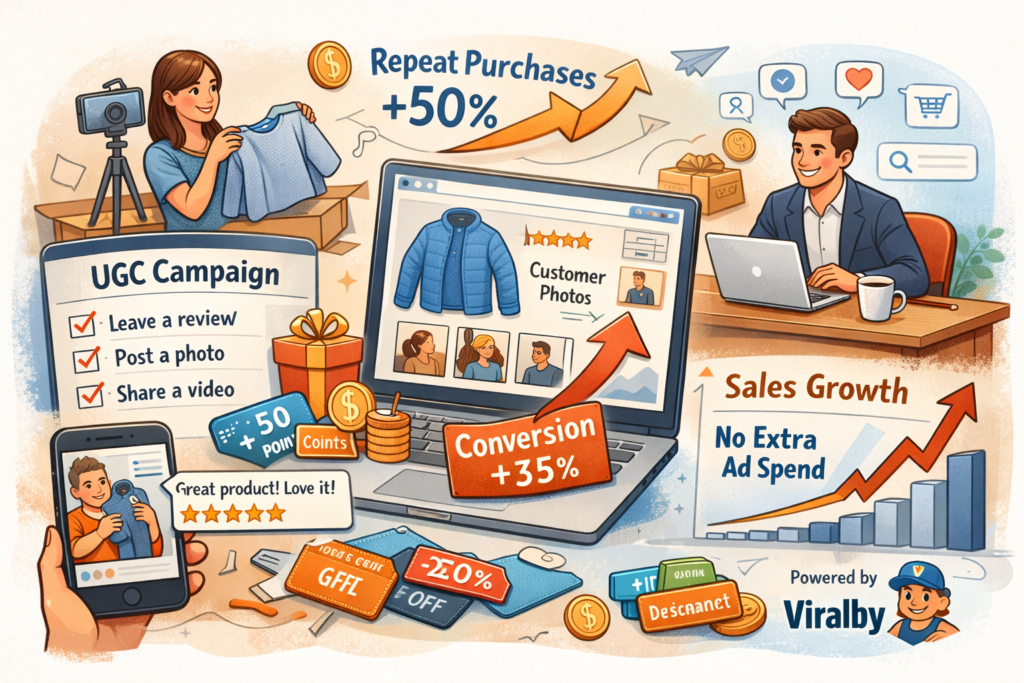
At some point, almost every online store hits the same wall. Advertising costs keep rising, margins shrink, and sales growth slows down. Increasing the ad budget feels like the obvious solution, but in many cases it only accelerates the problem. This case study shows how an e-commerce brand increased sales without increasing ad spend, and how the same approach can be applied in other stores.
The situation: sales stagnated while ads consumed margins
The business was a DTC e-commerce store selling everyday consumer products. The symptoms were familiar:
- customer acquisition costs were rising,
- website conversion rates remained flat,
- repeat purchases were lower than expected,
- new customer volume depended almost entirely on paid ads.
At the same time, the product quality was solid, returns were low, and customer support performed well. The issue was not the product. The issue was trust and the lack of convincing reasons to buy and come back.
The hypothesis: sales can grow through trust and conversion, not traffic
The team made a simple assumption. If trust around the brand increased, then:
- conversion rates would rise without additional traffic,
- repeat purchases would become more frequent,
- paid ads would perform better without higher spend,
Instead of chasing more clicks, the focus shifted to customer reviews and user-generated content as a system, not as a one-time effort.
What they did: step-by-step execution
Step 1. Identified where conversion was breaking down
The team analyzed the customer journey and found several weak points:
- product pages looked polished but lacked real-life context,
- reviews were outdated and too few,
- there were almost no customer photos or videos,
- after the first purchase, there was no clear reason to return,
The key insight was that visitors did not lack information. They lacked reassurance from other buyers.
Step 2. Defined UGC formats that directly influence sales
Next, the team identified which types of content actually reduce hesitation and improve ecommerce conversion:
- short, specific reviews explaining why the product was chosen,
- real photos showing how the product looks in everyday use,
- short videos with unboxing or first impressions,
- comparisons with alternatives and reasons for choosing this brand,
- mini case stories describing results after use.
These formats answered real buyer questions and performed much better than generic testimonials.
Step 3. Built systematic customer motivation with Viralby
The main challenge was consistency. Asking customers manually for content did not scale.
To solve this, the store introduced Viralby and set up a simple participation model:
- customers received clear post-purchase tasks,
- each task was short and measurable, such as a review with a photo,
- completed actions earned points,
- points could be exchanged for defined rewards like discounts, gifts, or free shipping,
This created a transparent value exchange. Customers knew why they were asked to participate, and the store received a steady flow of fresh content.
Step 4. Embedded UGC into key decision points on the site
Collected content was not stored separately. It was placed where it mattered most:
- reviews and photos were added to product pages,
- UGC blocks appeared near the buy button and shipping information,
- a dedicated section showcased real customer photos,
- selected content was reused in email flows for repeat purchases,
As a result, visitors consistently saw proof that real people were buying and using the products.
Step 5. Turned repeat purchases into a guided scenario
Retention was treated as a process, not a coincidence. The store introduced follow-up tasks such as:
- share results after 7 days,
- show how the product is used after two weeks,
- recommend the product to a friend in exchange for a bonus,
This created natural reasons to return without aggressive remarketing or constant discounts.
The results: sales growth without higher ad spend
Within a few weeks, clear changes appeared:
- product page conversion rates increased,
- repeat purchase rates improved,
- paid ads became more efficient due to higher on-site conversion,
- external reviews and mentions created additional organic visibility,
Importantly, the advertising budget remained unchanged. Growth came from better conversion and stronger trust signals.
An implementation plan for your e-commerce store
To apply this approach in your own business, the process can look like this:
- identify where conversion drops across your funnel,
- define 3 to 5 UGC formats that address buyer doubts,
- set up customer tasks with clear incentives,
- embed UGC into product pages, cart, email, and post-purchase flows,
- track changes in conversion, AOV, and repeat purchases
Final thoughts
Increasing sales without increasing ad spend is possible when the focus shifts from buying traffic to building trust. In e-commerce, customer reviews and structured UGC often unlock growth that advertising alone cannot buy.
If you want to test this approach without adding manual workload, starting with a small pilot using Viralby is a practical next step. Even a limited set of tasks can quickly show how customer-driven content affects conversion and repeat sales.