
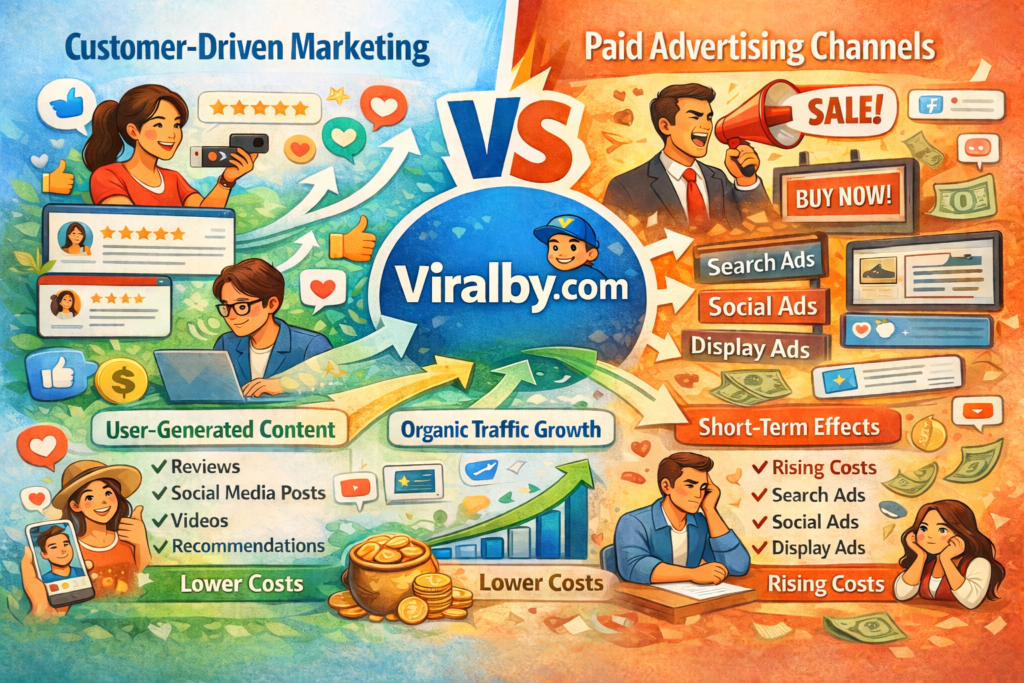
Paid traffic is still an essential part of modern marketing, but its economics are changing. Search ads, paid social, and display campaigns are becoming more expensive, while their results are increasingly unpredictable. Against this background, many businesses are discovering a simple but powerful pattern: when real customers talk about a brand, traffic tends to be more stable, more trusted, and often more cost-effective than traffic from traditional advertising channels.
Trust has more impact than creative execution
Even the best ad is still recognized as advertising. Users understand that someone paid for visibility, and that awareness creates distance. Customer stories work differently. Reviews, recommendations, and personal experiences are perceived as genuine signals, not sales messages.
Market research consistently shows that people trust customer opinions almost as much as personal recommendations from friends. This trust translates into behavior. Users spend more time engaging with content, feel less hesitation, and move faster toward decisions. That psychological shift is one of the main reasons why customer-generated traffic often outperforms paid campaigns in real conversion scenarios.
Paid traffic stops when the budget stops
Traditional advertising channels operate on a simple rule: as long as you pay, traffic flows. Once spending stops, visibility drops almost immediately. This makes paid channels effective for short-term acquisition but weak at creating long-term presence.
Customer content follows a different logic. Reviews get indexed by search engines. Discussions remain visible in communities. Posts and videos continue to attract attention long after publication. A single strong customer story can generate traffic for months, sometimes even years. Instead of a one-time expense, customer content becomes a lasting asset.
Customer content improves the economics of advertising itself
Even for businesses that actively invest in paid channels, customer content plays a crucial role. In many industries, cost per click has doubled or tripled over the past few years, while conversion rates have not followed the same trajectory. This forces companies to focus not only on acquiring traffic, but also on making that traffic convert better.
When landing pages and product pages are supported by authentic reviews, real usage photos, and customer stories, hesitation decreases. In practice, many businesses see conversion increases of 20 to 40 percent after systematically adding customer-generated content. This means paid traffic becomes more efficient without increasing budgets.
Ad fatigue keeps growing, customer content resists it
Users are exposed to hundreds of advertising messages every day. Over time, this creates advertising fatigue. Banners are ignored, sponsored posts are skipped, and brand promises are met with skepticism.
Customer content does not trigger the same reaction. It blends naturally into information streams and feels relevant rather than intrusive. Because of this, it retains effectiveness longer and often acts as the final reassurance that pushes a potential customer toward action.
Customers create more entry points than paid channels
Paid advertising is usually limited to a fixed set of platforms and formats. Customer content spreads much wider. It appears on review sites, social networks, professional communities, comment sections, blogs, and discussion threads. Each of these mentions becomes a new entry point into the brand.
Over time, this creates a perception of omnipresence. The brand feels familiar, visible, and validated by others. That perception is extremely difficult to achieve through advertising alone, regardless of budget size.
Why this rarely works without structure
If customer-driven traffic is so powerful, why do many companies struggle to benefit from it? The answer is operational complexity. Customers need guidance on what to share and where. Motivation must be clear. Content quality needs validation. Results must be measurable. Without structure, customer marketing becomes inconsistent and hard to scale.
How Viralby turns customer traffic into a system
Viralby addresses this operational challenge. Instead of relying on random mentions, the platform allows businesses to design clear customer tasks, define incentives, and track outcomes. Customers understand what to do and what they receive in return, while businesses gain a predictable flow of reviews, posts, and recommendations.
This turns customer-driven marketing from a spontaneous effect into a managed growth channel. It does not replace paid advertising, but it reduces dependency on it and builds long-term visibility that paid channels cannot sustain on their own.
Final thoughts
Paid advertising channels will remain part of the marketing mix, but they are no longer sufficient as a foundation for growth. Customer-generated content delivers something that ads struggle to buy: trust, context, and durability. Businesses that build marketing through customers gain traffic that compounds over time instead of disappearing when budgets are paused.
For many companies, the most practical next step is not a full transformation, but a small pilot. A few structured customer tasks, clear incentives, and defined success metrics are often enough to see how customer-driven traffic compares to paid channels in real conditions.