
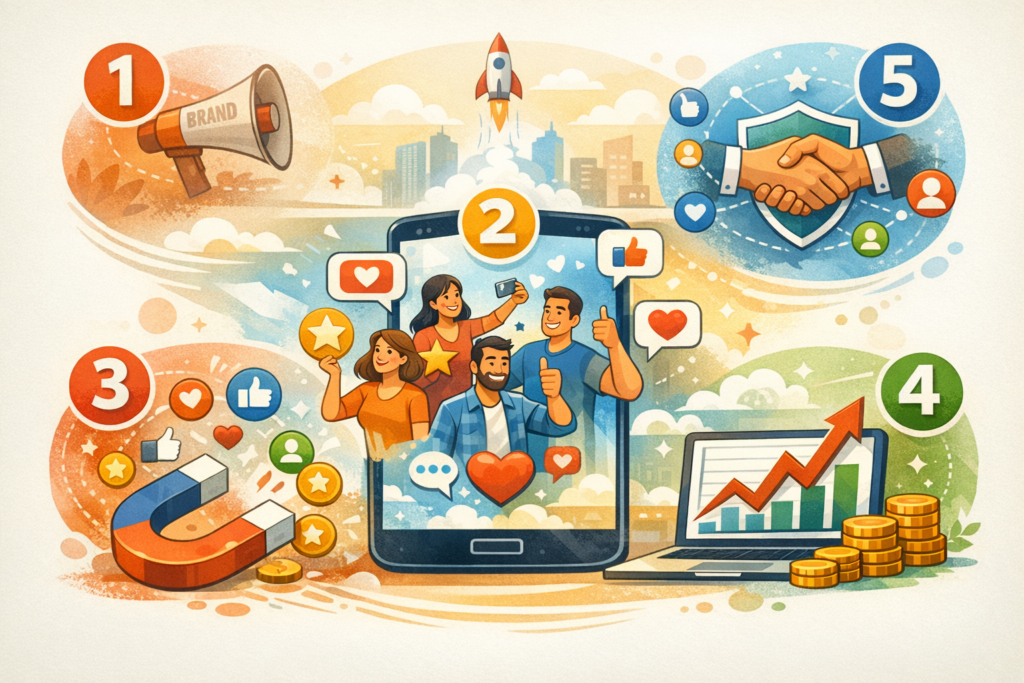
The future of marketing is changing not because brands have become weaker, but because the mechanics of trust have shifted. Today, sustainable growth is driven less by how loudly a brand speaks and more by how willing customers are to validate its value through their own experience.
Trust no longer belongs to brands
For years, brands controlled the narrative. They chose the channels, crafted the message, and decided how often it should be repeated. That model is losing effectiveness because trust no longer lives inside advertising formats.
Trust now lives in reviews, discussions, recommendations, customer stories, and real-world use cases that people encounter in search results, social platforms, and professional communities.
One statistic illustrates this shift clearly: according to Nielsen, nearly 90% of people trust recommendations from other people more than any form of advertising. This is the foundation of the trust economy, where value is shaped not by what a brand says about itself, but by what others say about it.
Why brand-centric marketing is losing efficiency
The issue is not that brand marketing has stopped working entirely. The issue is that it is no longer a reliable engine for long-term growth.
First, audiences are saturated with advertising. Banner blindness, ad blockers, and declining engagement rates are signs of fatigue. As a result, acquisition costs continue to rise while attention becomes increasingly expensive.
Second, brand messaging is perceived as biased by default. Even when a company is telling the truth, users instinctively discount it. When the same message comes from a customer, it carries a different weight because it is based on experience, not intent to sell.
Third, brands scale linearly through budgets and channels. Customers scale through networks. Every customer brings their own audience, context, and trust circle, creating parallel distribution that no single brand channel can replicate.
Customers are becoming the new marketing infrastructure
Customer-driven marketing is no longer a collection of isolated campaigns. It is evolving into a system where customers participate in growth continuously.
When a customer leaves a review, publishes a post, shares a case study, or recommends a product to a colleague, they do something advertising cannot replicate. They speak from lived experience.
This is why user-generated content consistently outperforms brand-created assets. Across industries, companies see conversion lifts of 20–40% when real customer stories, reviews, and examples are integrated into key touchpoints.
The trust economy creates growth that outlasts budgets
Paid channels behave predictably. As long as spending continues, traffic flows. When budgets stop, traffic disappears.
The trust economy works differently. Reviews remain indexed, discussions stay visible, and customer stories continue influencing decisions long after publication. More importantly, strong social proof improves the performance of paid traffic by reducing hesitation at the decision stage.
From a strategic perspective, this creates resilience. Growth is no longer tied exclusively to media spend but reinforced by accumulated trust.
Why C-level leaders are prioritizing customer advocacy
For CEOs and CMOs, the key question is not whether customers influence growth. The question is whether this influence can be structured, measured, and scaled.
Unstructured user-generated content is chaotic. Structured customer advocacy is a strategic asset. In B2B, SaaS, and education, where buying cycles are long and trust plays a decisive role, this distinction is critical.
Companies that invest in customer communities and advocacy programs often report retention increases of 15–25%. This means customer-driven marketing impacts both acquisition and lifetime value, not just awareness.
How Viralby enables customer-driven marketing at scale
Most companies already have loyal customers. What they lack is a system that turns loyalty into consistent, repeatable action.
Viralby helps businesses operationalize customer-driven marketing. Companies create clear tasks for customers: where to publish, what experience to share, and which formats work best. Customers receive transparent motivation, while businesses gain a measurable flow of reviews, publications, and recommendations.
As a result, customer advocacy becomes a controlled growth channel rather than a random byproduct of satisfaction.
Conclusion
Brands are not disappearing, but their role is changing. The brand is no longer the primary storyteller. It becomes the platform where customers validate value through their voices.
Organizations that align with the future of marketing by building growth around customers gain more than traffic. They accumulate trust. And in the coming years, trust will be the most scarce and valuable resource in the market.